

Racism & Integration in America
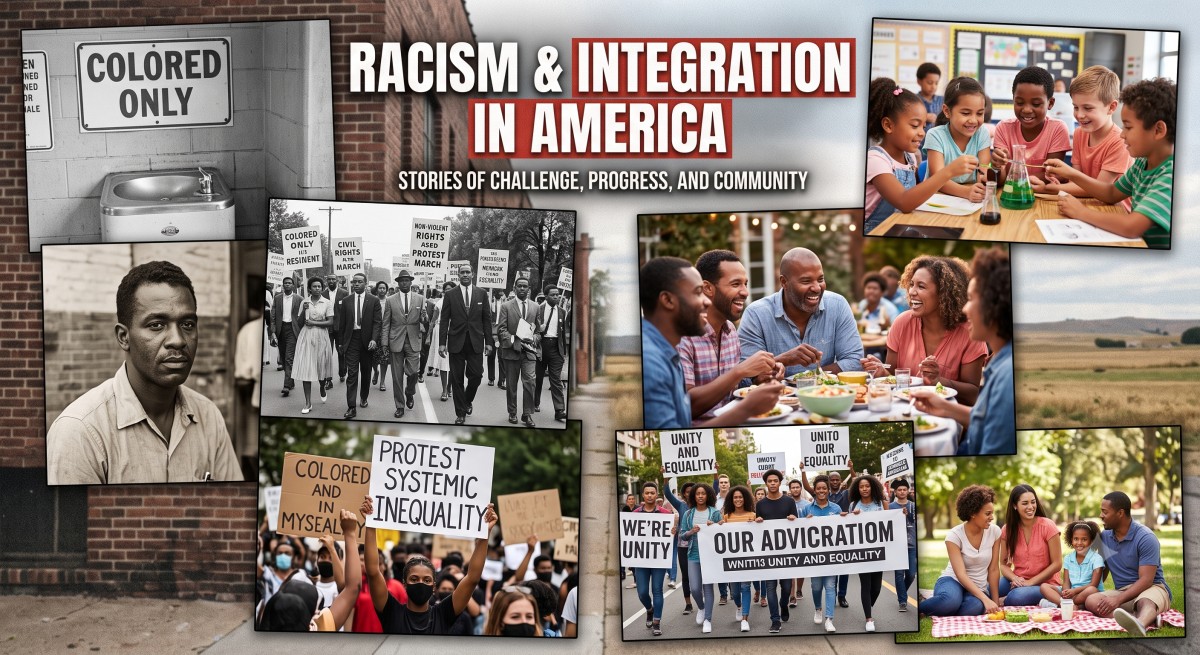
The United States has long grappled with the tension between its founding promise of liberty and equality and the realities of racial division. "Racism & Integration in America" examines how the nation has confronted systemic racism while pursuing the ideal of integration — the full participation of all racial and ethnic groups in shared institutions, communities, and culture. Progress has been substantial, yet challenges remain. This article explores the historical arc, major achievements, persistent issues, and ongoing debates surrounding race and belonging in American life.
Historical Foundations
Racism in America traces back to the earliest colonial period. The transatlantic slave trade brought millions of Africans to the colonies, establishing a system of racialized chattel slavery that became central to the Southern economy. Even after the abolition of slavery following the Civil War (1865), the Reconstruction era's brief promise of equality gave way to Jim Crow segregation, disenfranchisement, and widespread violence, particularly in the South.
The 20th century brought transformation. The Great Migration saw millions of Black Americans move from the rural South to Northern and Western cities, seeking opportunity but often encountering new forms of discrimination in housing, employment, and policing. World War II and the postwar period intensified demands for change, culminating in the Civil Rights Movement.
Landmark Progress Toward Integration
The Civil Rights era delivered historic victories:
- Brown v. Board of Education (1954): Declared segregated public schools unconstitutional.
- Civil Rights Act of 1964: Banned discrimination in public accommodations, employment, and education.
- Voting Rights Act of 1965: Protected minority voting rights.
- Fair Housing Act of 1968: Prohibited racial discrimination in housing.
These laws, combined with affirmative action policies and cultural shifts, dramatically expanded opportunities. Black homeownership, educational attainment, and entry into professional fields rose significantly. The election of Barack Obama as the nation's first Black president in 2008 symbolized profound change for many Americans.
Legal integration was accompanied by broader social and cultural integration. Interracial marriage rates climbed from less than 3% in 1967 to around 17-19% of new marriages today. Popular culture, sports, military service, and business became far more diverse. Asian, Hispanic, and other immigrant groups also contributed to America's evolving racial landscape, complicating the traditional Black-White binary.
Persistent Challenges
Despite undeniable progress, disparities remain:
- Economic and Educational Gaps: Black Americans continue to experience higher poverty rates, lower median household wealth, and differences in academic performance compared to White and Asian Americans. Factors include family structure, culture, educational choices, and lingering effects of past discrimination.
- Criminal Justice: Significant debates persist over policing, incarceration rates, and use of force. Black Americans are disproportionately represented in the criminal justice system, though violent crime rates have fallen dramatically since the 1990s across most groups.
- Residential Segregation: Many neighborhoods and schools remain racially homogeneous, driven by economics, personal preferences, and historical patterns rather than explicit legal barriers.
- Cultural and Political Tensions: Movements like Black Lives Matter (2020) highlighted real incidents of injustice but also sparked backlash over narratives of systemic racism, "defund the police," and identity-based policies. Critics argue that emphasizing race as the primary lens (often called "woke" ideology) can undermine social cohesion and individual agency.
Recent immigration has further diversified America. Hispanics are now the largest minority group, and Asian Americans have shown rapid socioeconomic mobility. This complexity challenges simplistic narratives of racism as the dominant explanatory force.
Debates on Solutions
Two broad approaches dominate contemporary discussion:
- Race-Conscious Policies: Supporters argue that targeted interventions — reparations discussions, race-based admissions, diversity quotas, and equity frameworks — are necessary to address historical and structural disadvantages.
- Colorblind Universalism: Critics contend that race-neutral policies focused on family stability, school choice, economic growth, and cultural factors (such as crime rates, single parenthood, and educational values) better promote genuine integration and long-term equality. They point to success stories among Asian immigrants and Nigerian/Ghanaian Americans as evidence that culture and behavior matter enormously.
The Supreme Court's 2023 decision ending race-based affirmative action in higher education reflected growing skepticism toward racial preferences. Public opinion polls consistently show majorities across racial groups favoring equal treatment over preferential treatment.
Looking Forward
America today is more integrated than at any point in its history. Multiracial identity is rising, especially among younger generations. Overt legal racism has been dismantled. Yet human tribalism, differing group outcomes, and cultural differences ensure that race remains a salient social category.
Sustainable integration likely requires:
- Honest data-driven analysis of group differences without excusing individual responsibility.
- Emphasis on shared American values and national identity over fragmentation.
- Focus on early childhood development, family structure, and education reform.
- Rejection of both naive colorblind denialism and corrosive race essentialism.
Racism exists — as prejudice and discrimination do in every diverse society — but its role relative to other variables (culture, economics, policy choices) remains hotly contested. America's greatest strength has been its capacity for self-correction and assimilation. The path forward depends on prioritizing individual character and opportunity over collective racial grievance.
Conclusion
The story of racism and integration in America is neither one of unrelenting oppression nor completed triumph. It is a complex, imperfect journey toward a more perfect union. By learning from history, embracing empirical reality, and recommitting to the principles of liberty and equal protection under the law, the United States can continue reducing racial friction while preserving its unique experiment in multi-ethnic democracy.
What's Your Reaction?
 Like
0
Like
0
 Dislike
0
Dislike
0
 Love
0
Love
0
 Funny
0
Funny
0
 Wow
0
Wow
0
 Sad
0
Sad
0
 Angry
0
Angry
0

Main Stream Media is a MESS! Press What Matters is of the people, by the people and for the people. The first amendment gives every United States citizen the right to be a journalist as free press and so does Press What Matters! Sign up today and post your own news article, story or video.








Comments (0)